Canadian FinTechs Continue to Lead DIY Investor Satisfaction, Closing the Trust Gap with Traditional Banks, JD Power Finds
Edward Jones Ranks Highest among Advised Investors, Wealthsimple Ranks Highest among Do-It-Yourself Investors
- More than half of investors who use a robo advice platform intend to seek human financial advice
- Majority of advisors reluctant to address the wealth transfer issue
- Female investors more likely to collaborate with partner on financial planning
Toronto, Canada: 2 Apr. 2026 — Canadian FinTechs not only continue to lead the do-it-yourself (DIY) investment segment in client satisfaction, compared to self-directed brokerages at traditional banks, but are also perceived to be more innovative and as trustworthy as those banks, according to the JD Power 2026 Canada Investor Satisfaction Study,SM released today. This investor sentiment, which has the highest positive impact on brand advocacy, is especially pronounced among younger investors (under age 40).
“This year’s study reveals growing risk and opportunity for FinTechs as well as the traditional banks,” said Mike Foy, managing director of wealth intelligence at JD Power. “FinTechs are winning DIY investors on innovation and closing the gap on trust, long considered a core advantage for the banks–and signaling intensifying competition. Simultaneously, growing demand for human financial advice among self-directed investors, especially young affluent ones, gives bank brokerages a valuable opportunity to retain clients and deepen relationships as those DIY investors transition toward advised offerings.”
Following are key findings of the 2026 study:
- High stakes increase appetite for human financial advice: As the portfolio values of young DIY investors under age 40 grow, so does their interest in seeking human financial advice. Nearly half (47%) of affluent DIY investors with $250,000 or more in assets say they plan to work with an advisor within the next year. Similarly, 45% of affluent DIY investors with children say they plan to use an advisor within the next 12 months, compared with only 22% of those without children in their household.
- Robo advice as a gateway to human advice: More than half (52%) of DIY investors who use a robo advice platform intend to enlist a human financial advisor during the next year, a trend that is even more pronounced among affluent DIY investors (60%). This suggests that digital tools are not replacing human financial advice, but instead may act as a gateway or stepping stone, identifying investors’ more complex needs and pushing them toward human guidance.
- Advisors reluctant to address the great wealth transfer: Only about one in three (31%) investors over age 60 say their advisor discussed the elements needed for future wealth transfer, and even fewer (11%) say their advisor met with or suggested meeting with family members to discuss the topic. This presents a critical industry blind spot and a missed opportunity for advisors to retain assets and build relationships with the next generation of clients.
- Financial planning partnership, the gender gap: Slightly less than half (49%) of married male investors under age 60 had their spouses join a meeting with a financial advisor, compared with 56% of married female investors in this age group who did the same. Collaboration between couples tightens among investors age 60 and older, with 74% of female investors and 69% of male investors having their partner attend a joint meeting with a financial advisor.
Study Ranking
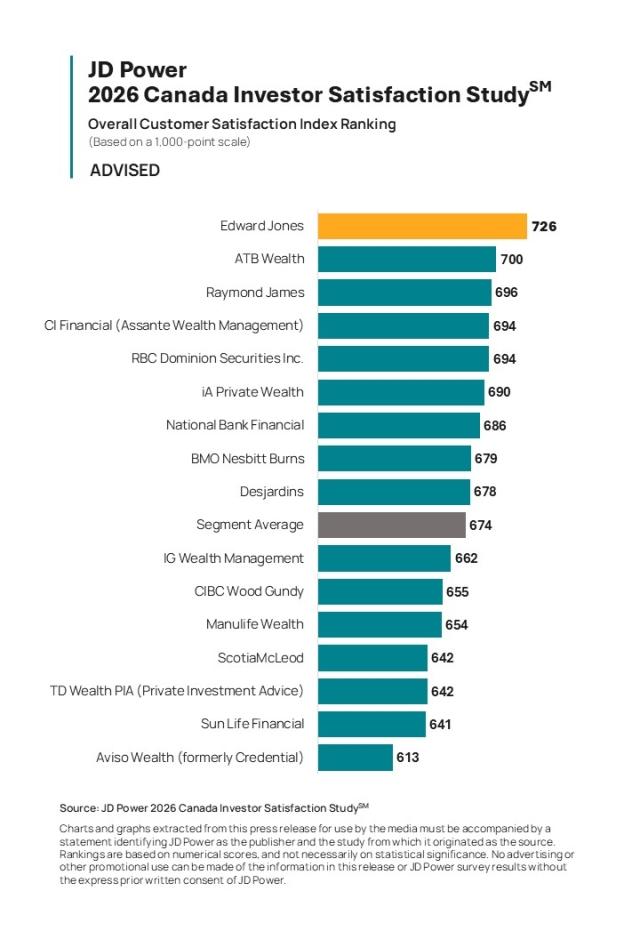
Edward Jones ranks highest in overall satisfaction among advised investors, with a score of 726 (on a 1,000-point scale). ATB Wealth (700) ranks second and Raymond James (696) ranks third.
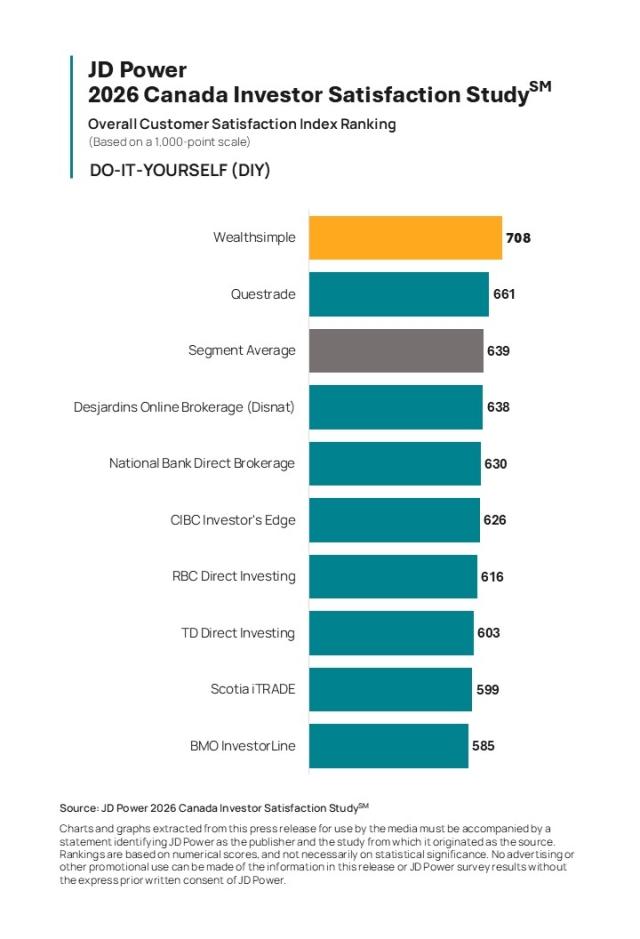
Wealthsimple ranks highest in overall satisfaction among DIY investors for a third consecutive year with a score of 708, followed by Questrade (661) in second place.
The Canada Investor Satisfaction Study evaluates the experiences of investors working with a wealth management firm, in either an advised or DIY capacity, in seven dimensions (in alphabetical order): digital channels; ease of doing business; people; product and service offerings; resolving problems or complaints; trust; and value for fees paid. The 2026 study is based on responses of 4,529 advised and 2,882 DIY investors and was fielded from September 2025 through January 2026.
For more information about the Canada Investor Satisfaction Study, visit https://www.jdpower.com/business/investor-satisfaction-study.
About JD Power
JD Power delivers mission-critical data, analytics and intelligence that help businesses improve customer experience and operational performance with confidence and clarity. Using proprietary, comprehensive data – including millions of consumer interactions and authoritative automotive datasets – combined with advanced analytics, artificial intelligence and deep industry expertise, JD Power enables leaders to respond to market shifts, make smarter decisions and drive measurable performance improvements.
As an objective source of deep insight into real-world customer interactions with brands and products, JD Power provides the independent intelligence organizations need to anticipate change, strengthen customer engagement and advance growth. Learn more at JDPower.com.
Media Relations Contacts
Gal Wilder, NATIONAL, Canada; 416-602-4092; gwilder@national.ca
Joe LaMuraglia, JD Power; East Coast; 714-621-6224; media.relations@jdpa.com
About JD Power and Advertising/Promotional Rules: www.jdpower.com/business/about-us/press-release-info